
Understanding the Core Fundraising Lingo: A Simple Guide to Term Sheets
For a first-time founder, the legal and financial terms are intimidating. They are looking for simple, clear definitions of the concepts that will define their company's future. Key Questions Answered: What is a "valuation," and how is a "pre-money" vs. "post-money" valuation calculated? What is a SAFE vs. a Convertible Note vs. an Equity Round? Which is best for me? What is "dilution" and how much of my company will I give away? What's a "cap table" and how do I build my first one?
Admin
10/7/20252 min read
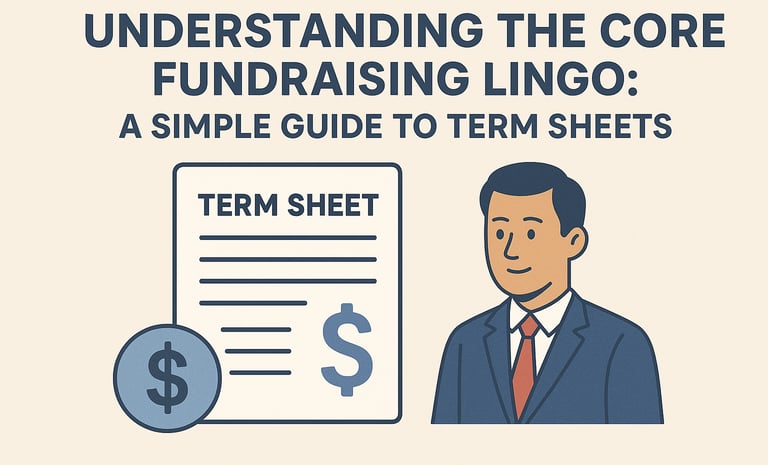
For first-time founders, confronting fundraising legal and financial jargon can feel overwhelming. Yet, these concepts shape your negotiation power, equity, and even the destiny of your startup. Here’s a simple guide to decoding the essential fundraising lingo found in term sheets—no legalese required.
What Is a Term Sheet?
A term sheet is a preliminary, mostly non-binding document that lays out the main terms and conditions between founders and investors before you sign formal investment agreements. It’s like a blueprint—a negotiation tool that covers valuation, equity, rights, exit options, and more so both sides know what’s at stake before lawyers put it into binding contracts.
Valuation: Pre-Money vs. Post-Money
Valuation is the value of your company agreed by both sides.
Pre-money valuation is your company’s value before new investment.
Post-money valuation is what it’s worth after adding the new cash.
For example, if your pre-money valuation is ₹18 crore and you raise ₹2 crore, your post-money valuation is ₹20 crore. The amount you raise, divided by the post-money valuation, tells you what percentage of your company you’re exchanging for the money.
SAFE, Convertible Note, or Equity Round—Which Should You Use?
SAFE (Simple Agreement for Future Equity): Fast, founder-friendly financing. Investors get the right to future equity but don’t set company value or get debt. Great for early rounds—simple documentation, no interest or maturity dates.
Convertible Note: A loan that converts into equity when you raise your next round. Investors can get interest and discounts. Useful if you’re expecting to set company value later.
Equity Round: Investors buy shares at a set valuation. Traditional, straightforward, and common in larger rounds.
Choice depends on stage and goals. Very early funding favors SAFEs and convertible notes for speed, simplicity, and flexibility. For later rounds or larger investments, formal equity rounds offer more clarity.
Understanding Dilution
Dilution is how much of your company you give away (reduce your ownership) when new investors come in. If you owned 100% before and issue 20% more shares to an investor, your share drops accordingly. Dilution is natural but keeping it controlled is vital for maintaining founder control and future fundraising leverage.
What’s a Cap Table, and How Do You Make One?
A cap table is a simple spreadsheet showing who owns what in your company. It lists founders, investors, option pools, and their respective share percentages. You update it every funding round, using it to track equity, understand dilution, and plan ownership changes. Building your first cap table can be as simple as listing all owners and how many shares they hold—before and after investment.
Mastering these terms will help you negotiate with confidence, interpret your term sheet, and protect your interests as you raise startup capital. Whenever in doubt, seek expert advice but always know precisely what you’re agreeing to when signing your first term sheet.
2025 Ennvest Pvt. Ltd. All rights reserved.

Ennvest is a fundraising platform that helps startups connect with global investors, streamline their capital-raising process, and access expert support for investor outreach and deal execution. It bridges the gap between founders and investors through data-driven insights and personalized fundraising solutions.
Quick Links
Home
About Us
Services
Blog
Contact Us
Legal & Policies
Resources
Consultation
Customer Support
FAQs
Blog